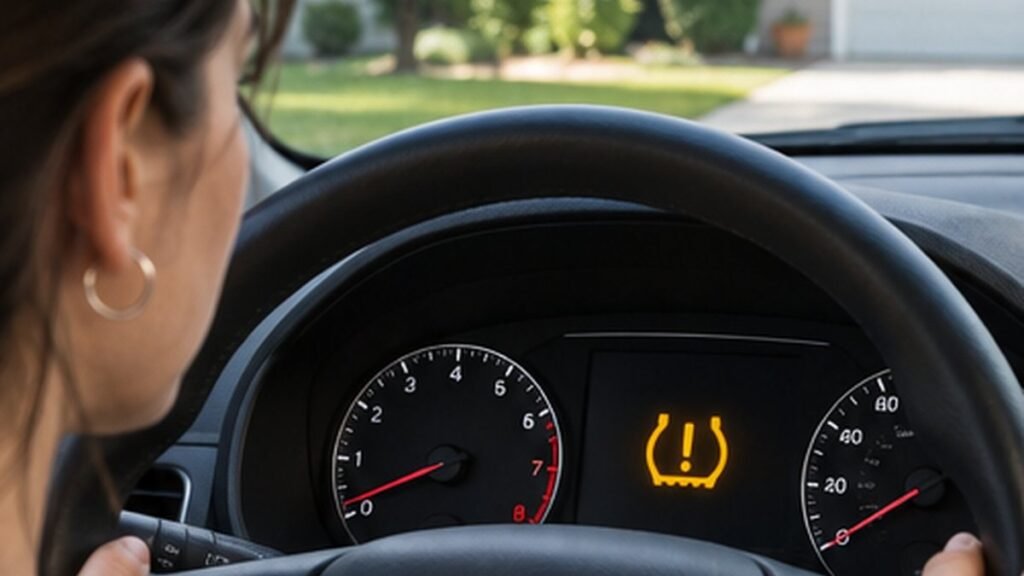
A cold morning can turn on the tire pressure light when an already marginal tire drops below the warning threshold. The useful next step is a pressure reading for each tire. If the car feels unstable or a tire is visibly flat, pull over safely and arrange help.
| Illustrative cold readings | What they suggest |
|---|---|
| 32, 32, 32, 32 psi on a 35-psi label | Adjust to the vehicle specification and monitor. |
| 35, 35, 35, 24 psi on the same label | Inspect the outlier for a leak before relying on it. |
| Correct pressures with a repeating blink pattern | Look up the warning and ask about the monitoring system. |
Find the car's pressure, then measure cold
Open the driver's door and look for the tire and loading label. It may list different front and rear pressures. The pressure molded into a tire's sidewall describes a tire limit. Use the vehicle label or the owner's manual for the pressure you should set.
Check with a gauge before driving, ideally after the car has sat for at least three hours. Take the valve cap off, press the gauge straight onto the valve and repeat a reading that looks odd. Check all four tires. If your manual says the spare is monitored, check its required pressure too.
Compare the numbers side by side
If the label calls for 35 psi and all four cold readings are close to 32, adjust to the label and monitor the next cold readings. If three read around 35 and one reads 24, prioritize the outlier. It could be a puncture, valve problem or another leak. Have it inspected, and avoid driving on a tire that cannot hold pressure.
Save readings by wheel position. A simple note such as “right rear 30 psi Monday, 26 psi Wednesday, both before driving” gives a tire shop a useful starting point. A visual glance alone is a poor substitute for a gauge, particularly with lower-profile tires.
Know what a blinking light adds
On many vehicles a warning that blinks at startup and then stays on can indicate a monitoring-system fault. Confirm the pattern in your manual. Check pressures anyway, then schedule a sensor or system check if the pattern persists. A wheel or tire change, seasonal wheels and sensor replacement can require a model-specific relearn.
Reset the warning only after pressures are correct and the manual says a reset is needed. If the light returns, compare pressures again before repeating the reset.
If the light comes back the next morning
Repeat the cold readings before adding air. Compare each corner with your original note. A drop isolated to the same wheel is more useful to a shop than a report that you reset the light twice.
Can I let air out if the gauge reads high after driving?
Check it when the tires are cold before making a routine adjustment. Driving warms the air and can raise the gauge reading above the cold specification. If you suspect a leak or have an unsafe reading, seek help rather than waiting to see what the dashboard does.
Sources
Featured and Web Story visuals are AI-generated editorial illustrations.