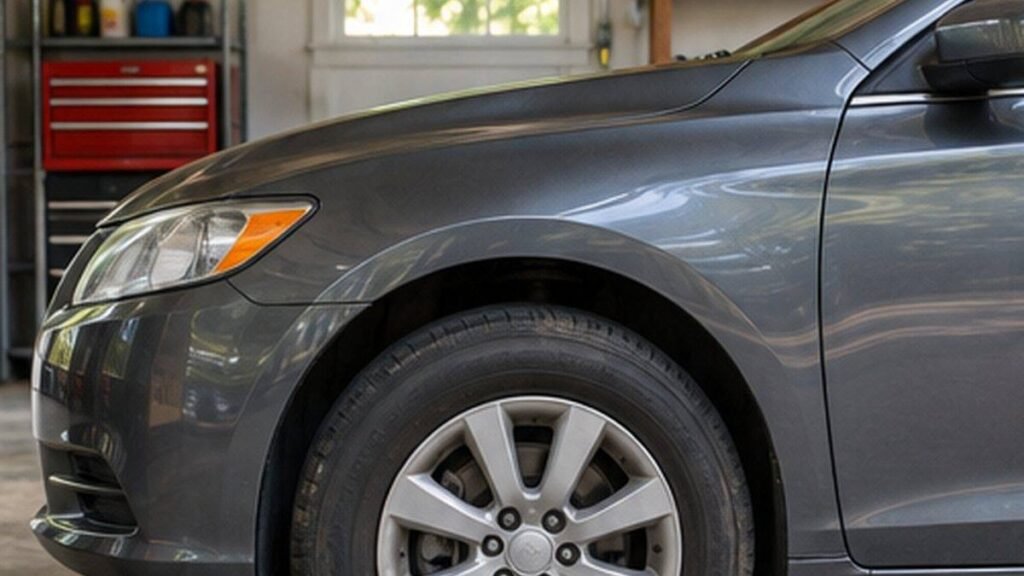
A flat tire on a level driveway is a very different job from a flat tire on a highway shoulder. If the car is near traffic, on a slope or on soft ground, call roadside assistance and follow local emergency guidance. The spare can wait until the location is safe.
| Check before lifting | Why it matters |
|---|---|
| Firm, level ground away from traffic | A jack needs stable ground and you need safe working space. |
| Correct jack point and wheel chock | The manual sets the position and procedure for your car. |
| Spare label and correct lug torque | The temporary wheel can have model-specific limits. |
Find out what you have
Check the trunk or cargo floor for a spare, jack, lug wrench and wheel lock key. Some cars carry an inflator and sealant instead. Follow the kit's instructions and limitations. A shredded tire, damaged wheel or large sidewall injury calls for assistance.
Read the owner's manual before you lift the vehicle. Find the model-specific jack point, parking instructions, wheel chock placement and any jack mode or special precautions. Check the spare's pressure and note its speed and distance limits. A spare that has sat untouched for years may need air before it's usable.
Keep the car stable
On a firm, level spot, switch on the hazard lights as appropriate, set the parking brake, secure the transmission and chock a wheel as the manual directs. Loosen the lug nuts slightly with the wheel still on the ground. Raise the car only at the approved jack point and only enough to clear the tire. Keep every part of your body out from under the car.
Remove the nuts and wheel, fit the spare and start the nuts by hand. Follow your manual for the lowering and tightening sequence, and use the specified torque. If you lack a way to confirm torque or the wheel does not seat properly, get help. Store the damaged wheel securely so it cannot move around in the cabin.
Treat a compact spare as temporary
Read the spare's own label and your owner's manual before driving. Some drivetrains have restrictions on which position can take a compact spare. Drive only within the specified limits and head for a tire shop. Mention the wheel position and whether you drove on the flat, which helps the shop assess damage.
If the spare is missing or flat
Check the manual for an approved inflator kit and its limits. If the kit is absent, expired or unsuitable for the damage, call for service. Tell dispatch whether you have a wheel lock and whether your drivetrain requires a specific tow procedure.
Can I repair the flat instead of replacing the tire?
Let a tire professional inspect it, including the inside. The location of the puncture, whether it was driven while flat and the condition of the tire all matter. A temporary spare or sealant may get you to service within its limits. Neither tells you whether the original tire is repairable.
Sources
Featured and Web Story visuals are AI-generated editorial illustrations.